

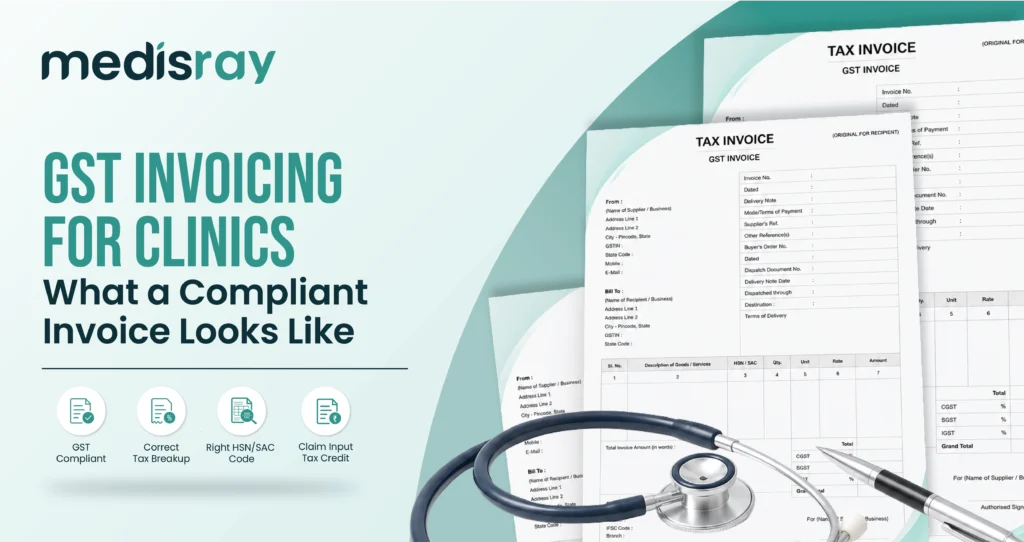
A GST-compliant clinic invoice in India must show the clinic’s name, address and GSTIN, the patient’s details, a unique invoice number and date, an item-wise description with HSN/SAC codes, the correct GST rate with a tax breakup, and a rounded total. Exempt consultations need a Bill of Supply; taxable items like medicines or aesthetic procedures need a tax invoice.
That one difference, exempt versus taxable is what trips up most clinics. A doctor’s consultation has no GST, but the paracetamol you sell at the front desk does. Use the wrong document and you risk losing your patient’s input tax credit, plus audit penalties and notices. This guide covers what belongs on a clinic invoice, the rates after the 2025 GST reforms, and three examples you can copy.
What must a GST-compliant clinic invoice contain?
A valid tax invoice must show the supplier’s name, address and GSTIN; a unique invoice number and date; the patient’s details; the place of supply; an HSN/SAC code and description for each line; the taxable value; the GST rate and tax split into CGST/SGST or IGST; the total; and a signature.
These fields come from Rule 46 of the CGST Rules, 2017, read with Section 31 of the CGST Act. Miss even one and the invoice becomes non-compliant which blocks your patient’s or corporate client’s input tax credit and can trigger an audit. Here is the full checklist for a clinic:
| S.no | Mandatory field | Notes for clinics |
| 1 | Clinic name, address and GSTIN | The legal name registered under GST |
| 2 | Invoice number | Unique, in order, maximum 16 characters, one series per financial year |
| 3 | Date of issue | The date the invoice is raised |
| 4 | Patient (recipient) name and address | Add GSTIN/UIN too if the patient or payer is registered (e.g. a corporate tie-up) |
| 5 | Delivery address + state + state code | Only if the recipient is unregistered and the value is above ₹50,000 |
| 6 | Place of supply | Decides whether you charge CGST+SGST (same state) or IGST (other state) |
| 7 | HSN / SAC code | SAC for services (healthcare is 9993); HSN for goods like medicines (Chapter 30) |
| 8 | Description of each line item | Be specific, vague entries like “treatment” cause audit problems |
| 9 | Quantity and unit | For goods such as medicines or implants |
| 10 | Taxable value | The value after any discount, per line |
| 11 | GST rate | Per line; different items can carry different rates |
| 12 | Tax amount | Split into CGST, SGST, IGST or cess as it applies |
| 13 | Total invoice value | Tax included, rounded to the nearest rupee |
| 14 | Reverse charge indicator | Mark “yes” only if reverse charge applies |
| 15 | Signature / digital signature | Of the clinic or an authorised signatory |
| 16 | QR code + IRN (e-invoice) | Only if your annual turnover is above ₹5 crore |
On code length: clinics with turnover up to ₹5 crore use a 4-digit code, and those above ₹5 crore use a 6-digit code on B2B invoices.
Do clinics charge GST on doctor consultations?
No. Healthcare services given by a clinical establishment, an authorised medical practitioner, or paramedics are fully exempt from GST. This covers consultations, diagnosis, treatment, in-patient care and patient transport. Since no tax is charged, a clinic issues a Bill of Supply for these services, not a tax invoice.
The exemption sits at Entry 74, Heading 9993 of Notification No. 12/2017-Central Tax (Rate). It applies without conditions, so a consultation fee carries no GST whether it is charged by a single practitioner, a large hospital, or one clinic billing through another. The trade-off: because the service is exempt, the clinic cannot claim input tax credit on costs tied to it.
One point many clinics miss: a Bill of Supply has no GST rate or tax columns at all, because there is no tax to show. Raising a “tax invoice” for an exempt consultation or showing 0% GST on a tax-invoice format is the wrong document.
Which clinic services and items are taxable?
The main taxable items are over-the-counter medicine sales, purely cosmetic or aesthetic procedures, and the standalone sale of goods like implants or devices. Diagnostic and lab tests done as part of a patient’s care are exempt, but products sold separately from treatment usually carry GST at their normal rate.
Here is how common clinic line items break down after the GST 2.0 reforms (effective 22 September 2025):
| Service / item | GST treatment | Document |
| Doctor consultation | Exempt | Bill of Supply |
| In-patient package (room, doctor, medicines during admission) | Exempt as a healthcare bundle | Bill of Supply |
| Diagnostic / lab tests as part of patient care | Exempt | Bill of Supply |
| Ambulance for patient transport | Exempt | Bill of Supply |
| Medicines sold over the counter | Mostly 5% (down from 12%); 18% for some; Nil for ~33 listed life-saving drugs | Tax invoice |
| Cosmetic / aesthetic procedures (hair transplant, botox, fillers, purely cosmetic surgery) | 5% without input tax credit (down from 18%), SAC 999722 | Tax invoice |
| Reconstructive surgery for congenital defects, trauma or injury | Exempt, treated as healthcare | Bill of Supply |
| Renting out clinic space or equipment | Taxable (usually 18%) | Tax invoice |
Two things to remember. First, what decides exempt versus taxable for a procedure is medical need: a nose reconstruction after an accident is exempt healthcare, while a cosmetic rhinoplasty for looks is taxable. Second, the cosmetic rate is a big recent change. Cosmetic and plastic surgery dropped from 18% to 5% without ITC under Notification No. 15/2025-Central Tax (Rate) from 22 September 2025, so any old template still charging 18% needs updating.
How should a clinic invoice mixed exempt and taxable items?
When one bill has both an exempt service (a consultation) and a taxable item (medicines), the clinic can issue a single Invoice-cum-Bill of Supply. This one document shows the exempt line with no tax and the taxable line with its GST breakup, so you don’t need two separate documents.
This rule was made for exactly this situation; a patient sees the doctor (exempt) and buys medicines on the way out (taxable). Section 31(3) and the related rules allow the combined document so you hand the patient one bill, not two. The taxable part must still carry every Rule 46 field HSN code, rate, tax amount while the exempt part simply shows the value with no tax.
Three sample clinic invoices
Sample 1: Simple consultation (exempt) → Bill of Supply
SUNRISE CLINIC BILL OF SUPPLY
12 MG Road, Bengaluru, Karnataka 560001
GSTIN: 29ABCDE1234F1Z5 No: BOS/2026/0418
Date: 16-06-2026
Patient: Rahul Mehta
Place of supply: Karnataka (29)
————————————————————
Description SAC Value (₹)
————————————————————
General consultation 9993 600.00
————————————————————
Total 600.00
(No GST charged exempt healthcare service)
————————————————————
Authorised signatory
No tax columns appear, because the service is exempt.
Sample 2: Consultation + pharmacy (mixed) → Invoice-cum-Bill of Supply
SUNRISE CLINIC INVOICE-CUM-BILL OF SUPPLY
12 MG Road, Bengaluru, Karnataka 560001
GSTIN: 29ABCDE1234F1Z5 No: ICB/2026/0931
Date: 16-06-2026
Patient: Rahul Mehta
Place of supply: Karnataka (29)
—————————————————————–
Description HSN/SAC Qty Taxable Rate CGST SGST
—————————————————————–
Consultation (exempt) 9993 1 600.00 Nil 0.00 0.00
Amoxicillin 500mg 3004 10 200.00 5% 5.00 5.00
—————————————————————–
Taxable value: 200.00 | Exempt value: 600.00
CGST (2.5%): 5.00 | SGST (2.5%): 5.00
Total GST: 10.00
Invoice total: 810.00 (rounded)
—————————————————————–
Authorised signatory
The consultation stays tax-free; the medicine carries 5% GST, split into 2.5% CGST + 2.5% SGST.
Sample 3: Aesthetic procedure (taxable) → Tax Invoice
SUNRISE CLINIC TAX INVOICE
12 MG Road, Bengaluru, Karnataka 560001
GSTIN: 29ABCDE1234F1Z5 No: INV/2026/0277
Date: 16-06-2026
Patient: Priya Sharma
Place of supply: Karnataka (29)
——————————————————————
Description SAC Taxable Rate CGST SGST
——————————————————————
Cosmetic procedure 999722 20,000.00 5% 500.00 500.00
——————————————————————
Taxable value: 20,000.00
CGST (2.5%): 500.00 | SGST (2.5%): 500.00
Total GST: 1,000.00
Invoice total: 21,000.00
——————————————————————
Authorised signatory (No ITC available on this supply)
A full tax invoice with the 5% rate, the tax split, and SAC 999722.
What are the most common GST invoicing mistakes clinics make?
The most common errors are using the wrong document (a tax invoice for an exempt consultation), the wrong HSN/SAC code, an outdated GST rate, a missing GSTIN on corporate bills, and wrong rounding. Each one can lead to input tax credit being rejected or to audit penalties.
The recurring ones, in detail:
- Wrong document:
A tax invoice for an exempt consultation, or a Bill of Supply for taxable medicines. Match the document to the supply.
- Wrong or missing HSN/SAC code.
A wrong code means the wrong rate, which often triggers a GST notice. Healthcare is 9993; medicines sit in Chapter 30; cosmetic procedures are 999722.
- Outdated rate.
Templates still charging 12% on medicines or 18% on cosmetic procedures after the 22 September 2025 changes.
- Missing GSTIN.
Leaving the recipient GSTIN off a corporate or insurance bill, which blocks the payer’s ITC.
- Wrong rounding.
Round tax to the nearest rupee, 50 paise and above rounds up, below 50 paise rounds down (Section 170 of the CGST Act). Rounding each line differently from the total causes mismatches.
- Out-of-order invoice numbers.
Gaps in the series, or a new series mid-year for no reason, raise audit flags.
How does clinic software automate GST-compliant invoicing?
A modern clinic management software platform keeps billing compliant by tagging each service or product with the right HSN/SAC code and GST rate, picking the correct document on its own, numbering invoices in order, working out the CGST/SGST/IGST split, rounding correctly, and creating e-invoices with IRN and QR codes when turnover requires it.
In practice, it removes the judgement calls that cause errors. When a receptionist bills a consultation plus medicines, the system sees one line as exempt and the other as taxable and produces a single Invoice-cum-Bill of Supply without anyone choosing which document to raise. Rate changes like the 2025 reforms are updated centrally, so no one is left charging last year’s percentage. It also keeps the exempt and taxable records separate, which is what auditors look for, and feeds clean data into GSTR-1 filing.
Medisray’s clinic billing software does all of this for clinics, hospitals and practices automatic code and rate mapping, the right document every time, e-invoicing, and audit-ready records so your billing stays compliant as the rules change. The lowest-friction next step is a 15-minute demo.
Frequently Asked Questions
What is the GST invoicing format for a medical store?
A medical store’s GST invoice follows the Rule 46 tax-invoice format: store name, address and GSTIN; a unique invoice number and date; buyer details; each medicine with its HSN code, quantity, rate and GST amount; the CGST/SGST or IGST split; and the rounded total, with an authorised signature.
Is GST charged on a doctor’s consultation in India?
No. Consultation fees charged by a clinic, hospital or authorised medical practitioner are exempt from GST as healthcare services under Heading 9993. The clinic issues a Bill of Supply, not a tax invoice.
Do clinics need to register for GST?
A clinic that supplies only exempt healthcare services does not need to register. But once taxable supplies: medicine sales, cosmetic procedures, equipment rental cross the threshold (₹20 lakh in most states, ₹10 lakh in special-category states), registration is required.
What is the difference between a tax invoice and a Bill of Supply?
A tax invoice is for taxable supplies and shows the GST rate and tax amount, so the buyer can claim input tax credit. A Bill of Supply is for exempt supplies (or composition dealers) and shows no tax, so no ITC can be claimed.
What GST rate applies to medicines sold at a clinic?
After 22 September 2025, most medicines are taxed at 5% (down from 12%), around 33 listed life-saving drugs are exempt (Nil), and a few stay at 18%. Medicines fall under HSN Chapter 30.
Are cosmetic and aesthetic procedures taxable?
Yes. Purely cosmetic work such as hair transplants, botox, fillers and aesthetic surgery is taxable. Since 22 September 2025 it is taxed at 5% without input tax credit under SAC 999722. Reconstructive surgery for trauma or congenital defects stays exempt.
Can one invoice include both exempt and taxable items?
Yes. A clinic can issue a single Invoice-cum-Bill of Supply that shows the exempt service with no tax and the taxable item with its full GST breakup, instead of two separate documents.
Is e-invoicing mandatory for clinics?
Only if the clinic’s annual turnover is above ₹5 crore. Those clinics must create an Invoice Reference Number (IRN) and QR code through the Invoice Registration Portal for B2B taxable supplies.
This article is general information, not tax advice. GST rates and rules change, the figures here reflect the position after the 22 September 2025 reforms. Confirm your clinic’s specific treatment with a qualified chartered accountant before finalising your billing setup.