

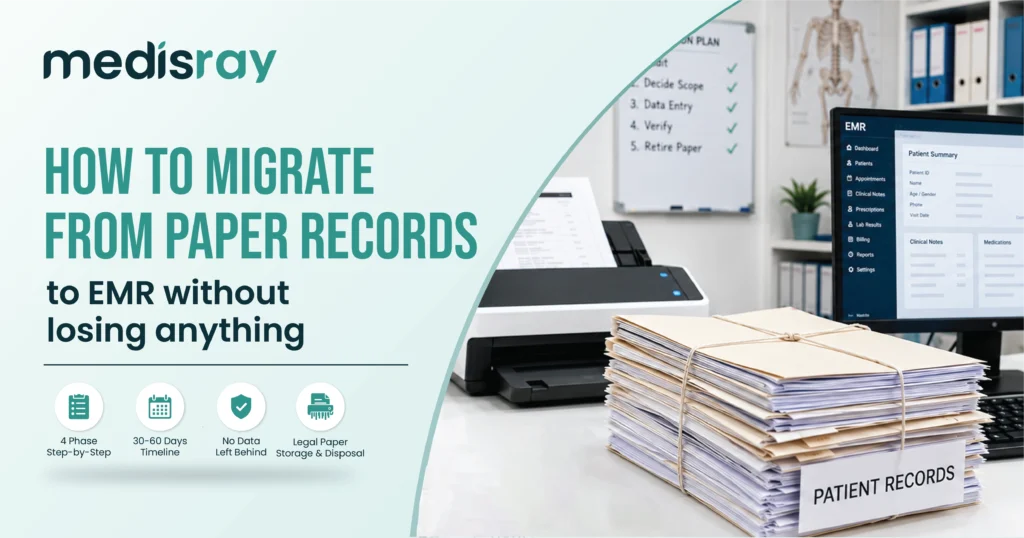
Migrating from paper records to EMR usually takes a typical clinic 30 to 60 days. You audit your existing files, decide what to digitise, enter the data into the new system in batches, run quality checks, then retire the paper. Done in phases, the clinic keeps running normally the whole time with no patient data lost.
The fear that stops most clinics is simple: what if something goes missing? A lost allergy note or an old lab result can change a treatment decision. The good news is that a paper-to-EMR migration in India is a well-trodden process. With a clear plan, quality checks at the right points, and the correct handling of old records, you move every record that matters and safely retire the rest. This guide walks through the full process. The four phases: a sample timeline, the tools and costs, how to guarantee nothing is lost, and how to store and dispose of paper the legal way.
How long does it take to migrate from paper records to EMR?
Most single-location clinics complete a paper-to-EMR migration in 30 to 60 days. The timeline depends on how many records you hold, how readable they are, and whether you digitise everything or only active patients. A small clinic with clean records can finish in three to four weeks; a busy multi-doctor practice may take the full two months.
The biggest variable is the number of records and their condition. Neat, typed or printed records move fast. Handwritten notes, faded carbon copies, and files split across registers slow things down because they need careful reading and sometimes re-entry. The second variable is scope, digitising only your active patient base (the people you’ve seen in the last one to two years) is far quicker than converting every file in the cupboard, and for most clinics it’s the smarter choice.
What are the four phases of a paper-to-EMR migration?
A paper-to-EMR migration runs in four phases: audit your paper records to see what you have, decide what to digitise, do the data entry into the new system, then retire the paper. Each phase has a clear finish line, so you always know how far along you are and nothing is skipped.
Phase 1: Audit your paper records.
Count and sort what you actually hold. Group files by type (consultation notes, lab reports, prescriptions, billing) and by age. Flag medico-legal files, incomplete records, and anything illegible. The output is a simple inventory: how many records, in what condition which sizes the whole project.
Phase 2: Decide what to digitise.
Not everything needs to move. The usual rule is to digitise all active patients in full, key history for occasional patients, and to exclude records past their legal retention period that you have no reason to keep. This single decision often cuts the workload by half or more.
Phase 3: Do the data entry.
Capture the records into the EMR by scanning by typing structured data, or both. This is the longest phase and the one where quality control matters most. Work in batches (for example, by doctor or by month) so progress is trackable and errors are caught early.
Phase 4: Retire the paper system.
Once a batch is entered and verified, mark those paper files as migrated and move them to secure storage or scheduled destruction. Run the clinic in parallel, paper and EMR together for a short overlap, then switch fully to the EMR once you trust the data.
What does a paper-to-EMR migration timeline look like?
A typical 45-day clinic migration breaks into roughly one week of audit, a few days to decide scope, four to five weeks of data entry with rolling quality checks, and a final week of verification and paper retirement. The clinic stays open throughout migration runs in the background.
Here is a sample timeline for a mid-sized clinic:
| Days | Phase | What happens |
| 1-7 | Audit | Inventory all files; sort by type and age; flag medico-legal and illegible records |
| 8-10 | Decide scope | Confirm what gets digitised in full, in summary, or excluded |
| 8-12 | Setup | Configure the EMR, set up the scanner, brief the data-entry team |
| 11-38 | Data entry | Enter records in weekly batches; run a 5% audit on each batch |
| 25-40 | Parallel run | Use EMR and paper side by side for live patients to build trust |
| 39-45 | Verify & retire | Final quality check; move verified paper to storage or destruction |
Adjust the length to your volume. The shape stays the same regardless of clinic size: audit first, decide scope, then enter and verify in overlapping batches rather than all at once.
What tools do you need to digitise paper records?
You need three things: a document scanner (a sheet-fed scanner for loose pages, or a flatbed for bound registers and fragile files), OCR software to turn scanned images into searchable text, and a data-entry team to key structured fields the OCR can’t read. Manual entry in India typically costs ₹3 to ₹5 per patient record.
A few practical notes on each:
- Scanner setup. A sheet-fed scanner handles loose A4 pages quickly; keep a flatbed on hand for stapled, torn, or bound records. Scan at 300 DPI so text stays legible, and save as searchable PDF where possible.
- OCR. Optical character recognition reads typed and printed text well, but handwritten doctor notes remain unreliable. Treat OCR as a first pass for printed material, not a substitute for human checking on handwriting.
- Manual data-entry team. For the fields that matter clinically: diagnoses, allergies, medications, key history – people enter structured data directly into the EMR. At roughly ₹3 to ₹5 per record, a backlog of a few thousand records is an affordable, predictable cost.
Your destination matters as much as your tools. Choosing the right EMR up front, one that structures clinical data properly and is easy for staff to use prevents rework later. If you’re still selecting a system, free clinic management software in India is a low-risk way to start structuring records before you commit budget.
How do you make sure no data is lost during migration?
Use a two-tier quality check: audit a random 5% of every batch entered and verify 100% of high-value records: medico-legal files, chronic-disease histories, allergy and medication lists, and anything tied to ongoing treatment. The random sample catches systematic errors; the full check protects the records where a mistake is dangerous.
This is the step that turns “we scanned everything” into “we lost nothing.” The 5% random audit on each batch tells you whether your team is making consistent mistakes; a misread date format, a skipped field – early enough to fix before it spreads across thousands of records. The 100% check on high-value records accepts that some files are too important to sample: an allergy missed during entry can directly harm a patient, so every one of those is read twice. Reconcile counts at each batch; files in should equal records out so a whole folder can never quietly vanish.
Which paper records should you not digitise?
Skip two kinds of records: Files that are past their legal retention period and that you have no reason to keep, and records so poorly written that digitising them would just copy errors forward. Old, expired records can be securely destroyed; illegible active records should be re-entered with the treating doctor, not blindly scanned.
On retention: India’s baseline is three years for in-patient records from the date treatment began (NMC Code of Medical Ethics, Regulation 1.3.1), though many records should be kept longer: medico-legal files until the case ends, pediatric records into adulthood, and chronic or surgical cases for much longer. If a record sits past every applicable retention period and isn’t tied to any open matter, it doesn’t need to enter your EMR.
On illegibility: a scan of an unreadable note is still unreadable, and a wrong entry typed from a guess is worse than no entry. For active patients whose paper records are hard to read, have the treating doctor re-enter the key clinical facts from memory and context, so the EMR starts clean rather than inheriting old errors.
Frequently Asked Questions
How long does a paper to EMR migration take in India?
Most single-location clinics finish in 30 to 60 days. The exact timeline depends on the number of records, how readable they are, and whether you digitise every file or only active patients. Smaller clinics with clean records can finish in three to four weeks.
How much does it cost to digitise patient records?
Manual data entry in India typically costs around ₹3 to ₹5 per patient record, plus one-time costs for a scanner and OCR software. Digitising only active patients rather than your entire archive is the biggest cost saver.
Do we have to digitise every old paper record?
No. Digitise active patients in full and key history for occasional patients. Records past their legal retention period with no open medico-legal or treatment link don’t need to move into the EMR and can be securely destroyed.
Can we throw away paper records after scanning them?
Only after the legal retention period ends. Three years minimum for in-patient records, longer for medico-legal, paediatric and chronic cases. Even then, records must be shredded, not dumped, to meet DPDP and clinical-establishment confidentiality rules. Keep a destruction log.
Is OCR accurate enough for handwritten doctor notes?
No. OCR reads typed and printed text reliably but struggles with handwriting. Use it as a first pass for printed material, and have staff or the treating doctor key in clinical fields from handwritten notes so nothing is misread.
Does the DPDP Act affect how we migrate records?
Yes. The DPDP Rules, 2025 treat patient records as personal data requiring secure storage, controlled access and safe disposal. They don’t reduce medical retention periods, they add confidentiality and security duties on top, which apply during and after migration.
This article is general information, not legal advice. Record-retention and data-protection rules vary by state and by case type, and the DPDP Rules are phasing in through 2027. Confirm your clinic’s specific obligations with a qualified professional before destroying any records.