

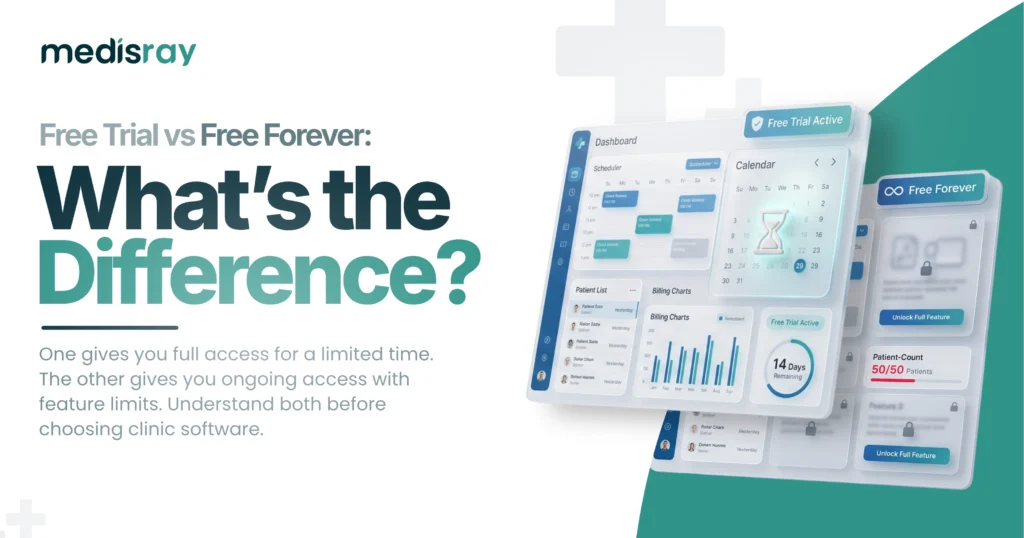
When you shop for clinic software, “free” shows up in two very different shapes, and confusing them leads to the wrong choice. A free trial clinic software offer gives you everything for a short time, then asks you to pay. A free forever plan gives you a limited version with no deadline. Both say “free,” but they work in opposite ways, and the right one for you depends on what you are actually trying to do. This guide explains clearly what each offer means, where the catch sits in both, and how to pick the one that fits your clinic. Understand the difference, and you will use these offers to your advantage instead of being surprised by them later.
Why “Free” Needs Unpacking
The word “free” does a lot of work in software marketing, and it hides more than it reveals. A clinic sees “free” and assumes it means one thing, then discovers the offer behaves completely differently from what it expected. The confusion is not an accident; it is easier to advertise “free” than to explain the conditions attached. So before you act on any free offer, it pays to ask which kind it is, because a free trial and a free forever plan lead to very different places. Unpacking the word first saves you from a nasty surprise a few weeks or months down the line.
What a Free Trial Actually Is
A free trial gives you the full, paid product for a limited time, often a couple of weeks, so you can try everything before deciding. The catch is simple and upfront: when the trial ends, you either pay to continue or lose access. A trial is not a long-term free option; it is a test drive. That makes it genuinely useful for one purpose, evaluating the software properly with your own clinic before committing, which is something every clinic should do. The key is to treat a trial as exactly that: a chance to test, with a clear decision to make at the end, not a free ride you can coast on.
What Free Forever Actually Means
A free forever plan is different: it gives you a limited version of the software with no time limit, so you can use it indefinitely without paying. The catch here is not a deadline but the limits. Free forever plans cap something, the number of patients, users or records, or hold back features like reminders, reports or proper billing. The provider offers it hoping you will grow into a paid plan once you rely on the tool. So “free forever” is real, but it is a capped version, not the full product for nothing. Understanding what is limited is the whole job of evaluating one.
The Catch in Each, Side by Side
Both offers are legitimate; they simply hide their condition in different places.
- Free trial: full features, but a deadline. The catch is time, you must decide and pay to keep using it.
- Free forever: no deadline, but limits. The catch is capability, you are using a capped version that may not grow with you.
Knowing which catch you are dealing with tells you how to use the offer. A trial is for testing before you buy; a free forever plan is for running a small or new clinic within its limits, as our guide on what free clinic software really gives you explains.
Which Offer Fits Your Situation
The right choice depends on your goal. If you want to evaluate software properly before paying, a free trial is ideal: use it to run real cases and make an informed decision. If you are a new or very small clinic that wants to get organised without spending yet, a free forever plan can genuinely serve you, within its caps. Many clinics use both in sequence: start on a free forever plan to get going, then take a free trial of a paid tier or a new tool when they are ready to evaluate an upgrade. Matching the offer to your goal is how you get value from either.
How to Use a Free Trial Well
A trial only helps if you actually test with it, so do not waste it. Run your real workflow through the software: book appointments, write a prescription, raise a bill, pull a report, and try exporting your data. Let the staff who will use it spend time with it. Note how long a normal visit takes end to end. Decide in advance what would make it a yes or a no, so the deadline forces a clear decision rather than a lapse. A trial used this way answers the only question that matters: does this tool fit my clinic? Drifting through it without testing wastes the one chance it gives you.
Reading the Fine Print on Free Forever
With a free forever plan, the fine print is where the real information lives. Before you rely on one, find out exactly what is capped: how many patients or users, which features are held back, and whether you can export your data if you decide to leave or upgrade. The last point matters most, because a free plan you cannot leave cleanly is a trap, however generous it looks. When you do outgrow it, our guide on moving from free to a paid plan covers doing that smoothly. Know the limits going in, and a free forever plan is a useful starting point rather than a surprise.
Know the Offer, Make the Right Call
Free trial and free forever are not the same thing wearing one label; they are two different offers with two different catches. A trial gives you the full product briefly so you can evaluate it, with a deadline attached. A free forever plan gives you a capped version indefinitely, with limits attached. Once you can tell them apart, you stop being surprised and start using each for what it is good at: trials for testing, free forever plans for starting small. That clarity turns “free” from a marketing word into a tool you can actually use.
If you want to start free and only pay when you are ready, Medisray’s free clinic software lets you begin without a deadline hanging over you, with a clear, flat, zero-commission path to a paid plan when you grow, and your data always yours to take. No trap, no surprise. Try Medisray free or book a demo, and see exactly what you get before you ever pay a rupee.
Frequently Asked Questions
What is the difference between a free trial and free forever clinic software?
A free trial gives you the full product for a limited time, then asks you to pay. A free forever plan gives you a capped version with no deadline. The catch is time for a trial and limits for free forever.
Is free forever clinic software really free?
Yes, but it is a limited version, not the full product. Free forever plans cap patients, users or features, offered in the hope you will upgrade once you rely on the tool. Check exactly what is limited.
What is the catch with a free trial?
The catch is the deadline. A trial gives you full features briefly so you can evaluate the software, but when it ends you must pay to continue or lose access. It is a test drive, not a long-term free option.
Which is better, a free trial or a free forever plan?
It depends on your goal. Use a free trial to evaluate software before buying, and a free forever plan to run a small or new clinic within its limits. Many clinics use both in sequence.
How do I make the most of a free trial?
Run your real workflow through it: appointments, a prescription, a bill, a report and a data export, let your staff test it, and decide in advance what makes it a yes or no, so the deadline forces a clear decision.
What should I check before using a free forever plan?
Find out what is capped, how many patients, users or records, which features are held back, and whether you can export your data if you leave or upgrade, so you are never locked in.
Can I switch from a free plan to paid later?
Yes, and a good free plan makes this easy. The key is data portability: as long as you can export your records, you can move to a paid plan or another tool without losing anything.
Is free clinic software safe for a real clinic?
It can be, if it protects data with encryption and access control and lets you export your records. Check how the provider funds itself and what security it offers before relying on it.