

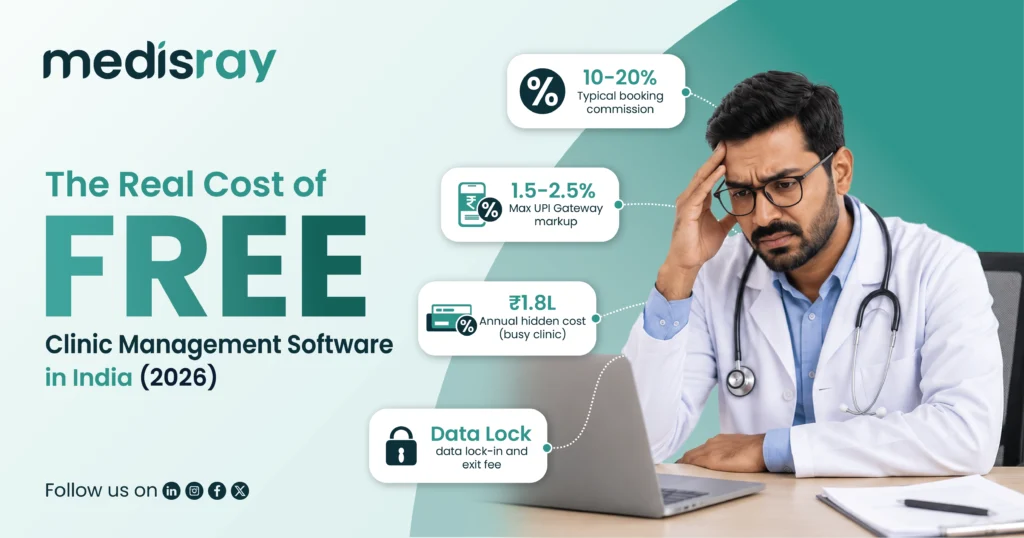
In Indian clinic software, “free” almost never means free. The three most common hidden costs are booking commissions (10-20%), payment gateway markups (1.5-2.5% on every UPI or card transaction), and data export fees if you decide to leave. For a typical clinic handling 200 bookings a month, these charges silently add up to ₹60,000-₹1,80,000 a year. This article breaks it all down, line by line and ends with a calculator, so you can run the numbers on your own clinic.
10-20% Typical booking commission
2.5% Max UPI gateway markup
₹1.8L Annual hidden cost (busy clinic)
Why Every Indian Clinic Software Offers a “Free” Plan
The freemium playbook was imported from generic SaaS and applied wholesale to healthcare. A free tier removes friction which gets the doctor in the door, and then the platform has three ways to make its money back.
1. Booking commission: A percentage cut on every consultation booked through the platform, often buried in the terms.
2. Payment gateway markup: A spread on UPI, card, or net banking flows. Money passes through the platform before you reach.
3. Upsell to paid plan: Often the lowest leverage of the three. Paths 1 and 2 are far more profitable on the marketplace scale.
Because paths 1 and 2 generate more revenue than subscriptions, the “free” plan stays free indefinitely, and the take rate quietly grows with your clinic volume.
Cost Breakdown: Four Real-World Clinic Scenarios
Let us model a realistic clinic. A general practice in a Tier 2 city, 1 doctor, 1 receptionist, average consultation 500 rupees, 200 bookings a month, 50 percent of those booked online, the rest walk in.
Variant A. Free plan with booking commission
Bookings: 200 per month
Online bookings: 100 per month
Average consult: 500 rupees
Online booked revenue: 50,000 rupees per month
Booking commission at 10 percent: 5,000 rupees per month
Annual cost: 60,000 rupees
Variant B. Free plan with payment gateway markup
Add to Variant A: all 200 bookings flow through the platform’s UPI gateway with a 2% markup. 200 times 500 rupees times 2% = 2,000 rupees per month. Annual: 24,000 rupees.
Total Variant A plus B: 84,000 rupees per year.
Variant C. Paid plan that says “no commission” but processes payments
A 999 rupees per month plan with a 1.5 percent UPI markup. Subscription: 11,988 rupees per year. Gateway: 18,000 rupees per year. Total: 29,988 rupees per year. Lower than Variant B but still substantial.
Variant D. Flat fee, no commission, no markup (Medisray Essential)
Subscription: 999 rupees per month. UPI lands directly in the doctor’s bank with no platform cut. Total: 11,988 rupees per year.
The difference between Variant A plus B and Variant D: 72,000 rupees per year. That is more than five months of subscription cost. For a busy clinic doing 400 to 500 bookings a month, the gap can exceed 1,80,000 rupees per year.
The Hidden Cost Nobody Talks About: Data Lock-In
Booking commissions at least show up on your bank statement. Data lock-in is invisible until you try to leave.
Switching free clinic management software in India today often means begging the previous vendor for a CSV export, paying a data migration fee of ₹5,000-₹25,000, manually re-keying patient fields that were custom to the old system, and rebuilding WhatsApp consent schedules from scratch. A clinic that runs on a “free” plan for three years and then wants to leave can spend ₹30,000-₹50,000 just to take its own data out. The “free” decision in year one becomes tax in year four.
What “Free” Should Actually Mean: A 5-Point Test
A free plan from a vendor that genuinely aligns with the doctor’s interests should pass all five of these:
1. No booking commission. Your patient’s payment is yours. The vendor takes nothing on the way through.
2. No payment gateway markup. UPI lands in your bank directly. The vendor never holds your money.
3. No exit fee. You can export your full patient history any time, in standard formats, for free.
4. No patient record cap. Some vendors limit the free plan to 100 patients, then charge to unlock. That is a hostage situation, not a free plan.
5. No silent feature degradation. Reminders work, billing works, EMR works. The free plan is a real product, not a teaser.
A 60 second test for any clinic software’s “free” plan
Open any clinic software’s pricing page. Without scrolling, check: Is the price in rupees visible? Is the booking commission rate stated? Is the UPI fee listed? Is the data export policy written down? Is the cancellation process clear? If three or more are missing, the plan is not free. It is just opaque.
What Medisray’s Free Clinic Management Software Plan Actually Looks Like
During beta, Medisray’s free plan is built to pass all five tests above. It includes:
✓EMR, appointment scheduling, and e-prescription generation
✓GST-compliant billing and invoicing
✓UPI QR payments, money goes directly into your bank, zero platform cut
✓1 doctor, 1 location, no artificial patient record cap
✓No credit card required, no exit fee, no data lock-in
The plan is free because we are in beta and want real-world feedback, not revenue, this quarter. That’s the honest reason.
Run the numbers. Then decide.
If your annual “free” tax is over ₹50,000, you have a strong case for switching. Start the Medisray free plan in under 5 minutes. no card, no lock-in.
Start Free | Compare All Plans
Frequently Asked Questions
Are all free Indian clinic software plans the same?
No. Fee structures vary widely across vendors. Some take booking commissions, some take gateway markups, some take both, and some take neither. Always run the 5-point pricing page test before you sign up for any free plan. If three or more key terms are not visible without scrolling, treat the plan as opaque, not free.
Is a flat-fee plan always cheaper than a free plan with commission?
For clinics handling more than 50-100 paid bookings per month, almost always yes. Below that volume, a no-commission free plan with no gateway markup can genuinely be the lowest-cost option. The calculator above will tell you exactly where your clinic sits.
Are UPI charges not unavoidable for clinics?
No, UPI from a business account directly to a bank account carries no merchant discount rate (MDR). Charges only appear when a payment processor inserts itself in the middle. Some clinic software vendors do exactly this, collecting the patient’s UPI payment into their own float and then remitting to you, minus a percentage. You can avoid this entirely by using your own UPI QR linked directly to your bank.
What should a genuinely free clinic software plan include?
No booking commission, no payment gateway markup, no exit or data export fee, no artificial patient record cap, and no silent degradation of core features like EMR, billing, or appointment reminders. If a free plan passes all five of these, it is genuinely free. If even one fails, calculate the real annual cost before committing.